The cash flow gap in construction
In engineering and construction, the biggest risk to a business is rarely a lack of work. It is the gap between paying for materials and labour today, and getting paid by the client months down the line. Even profitable projects can go under if the money does not arrive when the bills are due.
Retention sums, delayed valuations and slow payment chains mean your bank balance can drop sharply while your order book looks full. A cash-flow forecast helps you see those low points weeks before they hit, giving you time to act.
- Labour and material costs land upfront
- Valuations and certifications take time
- Retentions tie up working capital
What to set up first
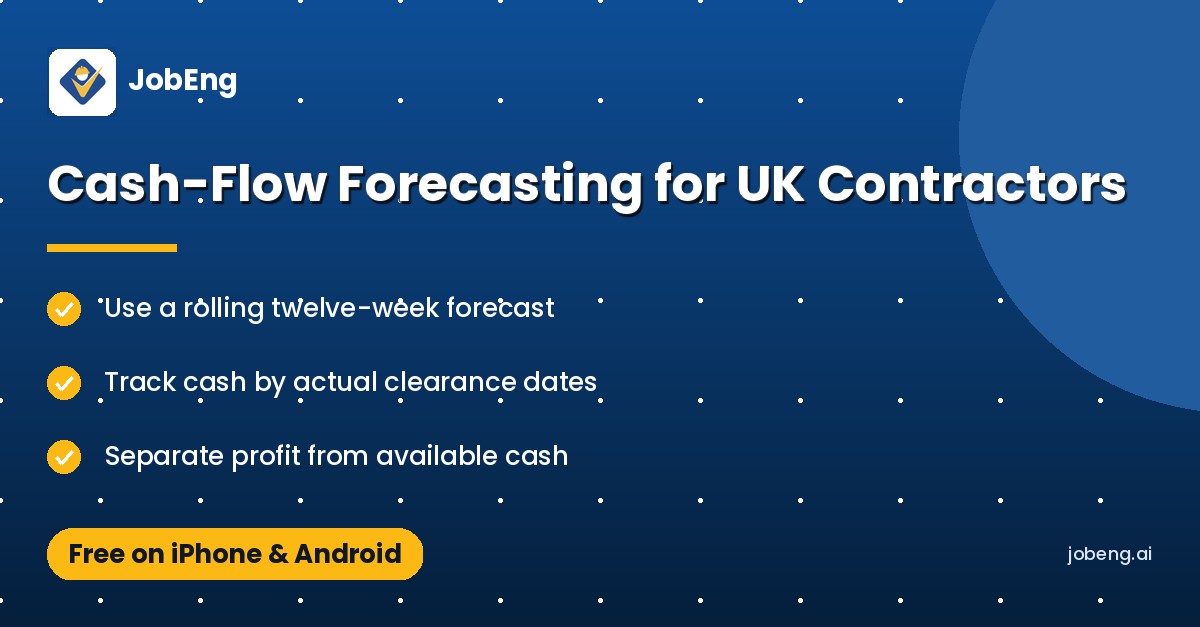
Start with a simple rolling twelve-week forecast. Twelve weeks gives you enough horizon to spot upcoming shortfalls without getting lost in guesswork for next year. List every expected cash inflow by the date you realistically expect the money to clear your account, not the date on the invoice.
On the outflow side, include fixed overheads like rent, insurance and loan repayments, alongside direct project costs such as subcontractor payments and plant hire. Be honest about when payments leave your bank account rather than when bills are issued.
- Use a twelve-week rolling window
- Record cash by clearance date
- Include all overheads and project costs
Where JobEng helps
Cash-flow forecasting for contractors. JobEng is an app for UK engineering and construction, on iPhone and Android with the same account on the web. Firms use it to hire engineers and run the business side of their projects.
Handling applications and valuations
Your forecast relies entirely on the accuracy of your payment applications. If your interim application is late, incomplete or submitted incorrectly, the payment notice from the client or main contractor will likely be delayed too.
Track the exact dates set out in your contract for issuing notices, payment certificates and final cash receipt. Build these milestones directly into your timeline so you know immediately if a client misses a payment deadline.
- Submit payment applications strictly on time
- Track contract payment notice dates
- Follow up immediately on overdue certificates
Common mistakes to avoid
The most frequent error is confusing profit with cash. A project showing a strong margin on paper will still drain your account if the client pays in sixty days while your subcontractors expect payment in thirty.
Another common pitfall is failing to account for VAT liabilities and PAYE payments. HMRC deadlines are fixed, and missing them leads straight to penalties regardless of whether your clients have paid their invoices yet.
- Do not confuse profit with available cash
- Always include HMRC and VAT liabilities
- Avoid optimistic dates for client payments
Action steps when a shortfall looms
If your forecast shows a negative balance coming up next month, take action immediately rather than waiting for the account to empty. Talk to your main contractors early if an interim valuation is held up.
Review your upcoming material purchases to see if orders can be staggered or if credit terms with suppliers can be temporarily extended. Check official government guidance on late payment rules and dispute resolution if a client refuses to pay valid sums.
- Act weeks before the shortfall hits
- Communicate early with suppliers
- Review contract payment terms
How to start
- Download JobEng free from the App Store (iPhone) or Google Play (Android).
- Create a business account for your firm — firms can ask about a free month of the full platform.
- Open JobEng and start with: cash-flow forecasting for contractors.
Download JobEng free
The whole platform for your firm, on your phone. On iPhone and Android, with the same account on the web.
Frequently asked questions
How far ahead should a contractor forecast cash flow?
A rolling twelve-week forecast is standard for day-to-day operations, supplemented by a longer twelve-month view for strategic planning and tax liabilities.
What is the difference between profit and cash flow?
Profit is the financial gain after expenses when work is completed, whereas cash flow is the actual timing of money moving in and out of your bank account.
How do retentions affect contractor cash flow?
Retentions hold back a percentage of each payment until defects liability periods end, locking up working capital that you might otherwise use for day-to-day costs.
Where can I check official rules on construction payment disputes?
Check UK government guidance on the Construction Act and consult official bodies like the RICS or ICE for standard adjudication and payment dispute procedures.
JobEng is free to download on iPhone and Android. Firms can ask about a free month of the full platform.
Questions about the product or your data? See support and the privacy policy.